Get flat 10% off, Use code FLAT10

Meet Gen Alpha: The First Truly Digital Kids
Gen Alpha is the first generation born into a fully digital world, where screens, videos, and instant access are part of everyday life. This blog explores who Gen Alpha really is and why platforms like YouTube feel so natural to today’s kids.
GROWING TOGETHER - PARENTING LESSONS
1/25/20264 min read
My post content
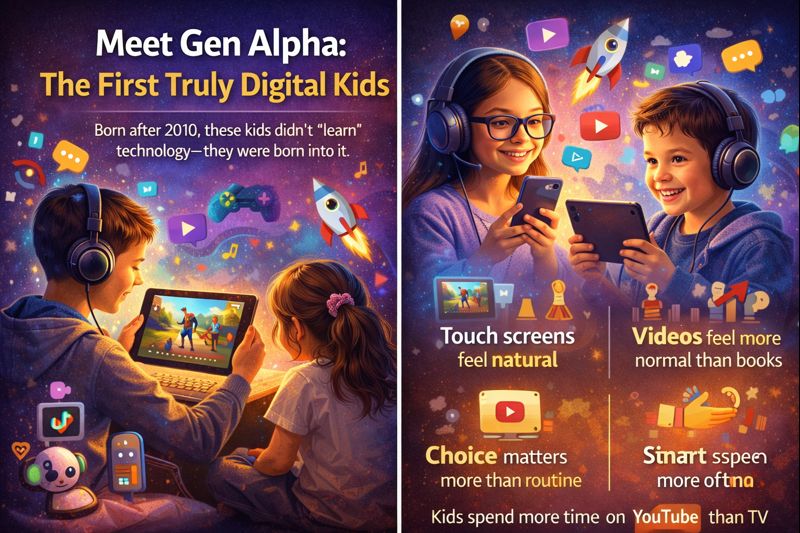
Gen Alpha refers to children born roughly after 2010. This is the first generation that didn’t grow up alongside technology—they were born into it. Smartphones, tablets, smart TVs, voice assistants, and high-speed internet were already part of everyday life when they opened their eyes to the world. For them, digital is not a tool. It is the environment.
Unlike Millennials or Gen Z, Gen Alpha did not “learn” technology later. There was no transition phase from analog to digital. Swiping, tapping, scrolling, and voice commands feel as natural as turning a page once felt to older generations. This early exposure is quietly reshaping how they think, learn, communicate, and express creativity.
For Gen Alpha, interaction matters more than instruction. Touch screens don’t need manuals. Visual cues feel clearer than long explanations. Videos often feel more engaging than plain text because they combine sound, motion, emotion, and story in a single experience.
Some core traits that define Gen Alpha include:
• Touch-based interaction feels instinctive
• Visual and video content feels more natural than long text
• Choice and personalization matter more than fixed routines
Global digital behavior studies show a clear pattern: children today spend more time on online video platforms than on traditional television, and this gap widens every year. In both India and the USA, YouTube consistently ranks as the most-used digital platform among children aged 5–14. This trend is not limited to entertainment—it extends to learning, curiosity, hobbies, and even problem-solving.
This tells us something important. YouTube is not just popular among Gen Alpha. It fits seamlessly into how they consume information. Short videos, animated explainers, music, storytelling, and interactive visuals align perfectly with their attention patterns and learning preferences.
For Gen Alpha, learning does not always feel like “studying.” Watching a science experiment video, a storytelling animation, or a how-to tutorial often feels like play. This doesn’t mean they are less capable of focus—it means their focus is driven by engagement rather than obligation.
Key reasons video platforms resonate so strongly include:
• Information is delivered visually and quickly
• Content is available on demand, not on schedule
• Kids can choose what they want to explore next
Another defining feature of Gen Alpha is choice. Unlike previous generations that followed fixed TV schedules or school-driven learning paths, Gen Alpha expects control. They are used to selecting videos, skipping content, replaying favorite parts, and exploring topics in their own sequence. This sense of autonomy shapes their confidence and curiosity.
Books are not irrelevant to Gen Alpha, but the format matters. Static text without visuals often struggles to compete with animated storytelling, colorful illustrations, and audio-visual cues. When books integrate illustrations, activities, and visual imagination, they still hold strong appeal.
This shift doesn’t signal the decline of reading—it signals the evolution of how stories are consumed. Stories that combine visuals, emotions, and interactivity resonate more deeply with Gen Alpha’s digital-first mindset.
Parents and educators often worry about screen time, but the conversation is slowly shifting from how much to how meaningful. Not all screen time is equal. Passive consumption and purposeful engagement are very different experiences. Educational videos, guided storytelling, creative apps, and learning-focused content can stimulate imagination and critical thinking when used responsibly.
Gen Alpha also grows up observing adults using technology for everything—payments, navigation, communication, work, and entertainment. This normalizes digital dependency but also increases digital literacy at an early age. Children quickly understand that screens are not just for fun; they are tools for solving problems.
Another important factor shaping Gen Alpha is speed. Content loads instantly. Answers are a search away. Waiting feels unnecessary. This influences patience levels but also sharpens adaptability. They expect systems to respond quickly and intuitively.
Common behavioral patterns seen in Gen Alpha include:
• Faster visual processing
• Shorter attention windows for unengaging content
• Strong preference for interactive experiences
This does not mean Gen Alpha lacks depth. When deeply interested, they can focus for long periods, especially on games, creative tools, or storytelling they love. Engagement, not duration, determines attention.
Education systems around the world are slowly adapting to this reality. Digital classrooms, smart boards, video-based learning modules, and interactive assignments are becoming more common. In many cases, students respond better when learning feels immersive rather than lecture-driven.
For content creators, publishers, and educators, Gen Alpha represents both a challenge and an opportunity. Traditional formats need rethinking. Content must be designed with clarity, simplicity, visual appeal, and purpose. Overloading information no longer works. Clear storytelling does.
What works best for Gen Alpha content:
• Short, meaningful segments
• Strong visuals and sound
• Simple language with clear intent
This is why kids’ content on platforms like YouTube continues to grow rapidly. Animated rhymes, educational shorts, moral stories, DIY activities, and fun learning videos fit naturally into daily routines. Many children discover interests through videos before exploring them offline.
Importantly, Gen Alpha is also growing up with global exposure. A child in India may watch the same educational video as a child in the USA or Europe. This creates shared cultural references and broadens perspectives early in life.
However, this also places responsibility on adults. Algorithms influence discovery. Content quality matters. What children watch repeatedly shapes values, behavior, and curiosity. Responsible curation and thoughtful content creation are more important than ever.
Gen Alpha also values authenticity. Overly polished, forced, or adult-styled content often feels disconnected. Content that feels playful, honest, and child-centered tends to perform better and build trust.
As this generation grows, their expectations will shape future platforms. Interfaces will become more intuitive. Learning will become more visual. Entertainment will blend seamlessly with education. Brands, educators, and publishers who understand Gen Alpha today will stay relevant tomorrow.
Gen Alpha is not “addicted” to technology. They are fluent in it. Just as previous generations were fluent in books, radio, or television, this generation is fluent in digital ecosystems.
Understanding Gen Alpha is not about resisting change. It’s about guiding it thoughtfully. When used correctly, digital platforms can nurture creativity, curiosity, confidence, and learning at scale.
Gen Alpha is the first truly digital generation. They are growing up in a world where screens are not distractions—they are gateways. And those who learn to speak their language will help shape a smarter, more creative future.