Get flat 10% off, Use code FLAT10
Panchatantra: The Timeless Indian Guide to Wisdom Through Stories
Panchatantra is a timeless collection of ancient Indian stories that teach children and adults the art of wise living through simple yet powerful storytelling. Written by Vishnu Sharma, these stories use animals as characters to explain important life lessons about friendship, trust, intelligence, leadership, and decision-making.
PANCHATANTRA STORIES
2/2/20266 min read
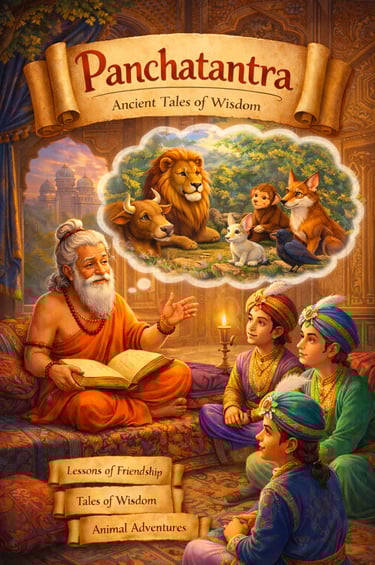
Panchatantra
The Timeless Indian Guide to Wisdom Through Stories
The Panchatantra is one of the greatest treasures of Indian literature and moral education. It is not just a collection of stories, but a carefully designed system to teach wisdom, intelligence, relationships, leadership, and life skills through simple and engaging storytelling. Written more than two thousand years ago, the Panchatantra continues to guide children and adults across cultures and generations.
Unlike ordinary storybooks, Panchatantra stories are practical. They do not preach directly. Instead, they allow readers to observe actions, consequences, and choices, making learning natural and memorable.
Why should you encourage your kids to read Panchatantra stories?
You should encourage your kids to read Panchatantra stories because they teach life lessons in the most natural and enjoyable way. Instead of preaching, these stories help children understand values like honesty, friendship, wisdom, courage, and smart decision-making through engaging animal characters and simple plots.
Panchatantra stories improve a child’s thinking skills by showing the consequences of good and bad choices, helping them learn how to handle real-life situations with intelligence and emotional balance. They also nurture imagination, build moral strength, and develop communication skills, making children not just good readers, but wise thinkers for life.
Panchatantra stories improve a child’s thinking skills by showing the consequences of good and bad choices, helping them learn how to handle real-life situations with intelligence and emotional balance. They also nurture imagination, build moral strength, and develop communication skills, making children not just good readers, but wise thinkers for life.
Origin and Purpose of Panchatantra
The Panchatantra was originally written in Sanskrit by the scholar Vishnu Sharma. According to legend, a king once asked Vishnu Sharma to educate his three sons, who were intelligent but uninterested in learning traditional scriptures. Vishnu Sharma promised to teach them the art of living and ruling—not through dry lessons, but through stories that entertain and educate at the same time.
Thus, the Panchatantra was created as a manual of practical wisdom, especially for young minds. Its purpose was not religious teaching, but worldly intelligence (Nīti)—how to think, decide, choose friends, avoid danger, and live wisely.
Meaning of Panchatantra
The word Panchatantra comes from:
Pancha – Five
Tantra – Principles, strategies, or systems
So, Panchatantra means “Five Principles of Life Wisdom.”
These five principles are presented as five books, each focusing on a specific aspect of human behavior and social life.
Unique Storytelling Style
One of the most fascinating aspects of Panchatantra is its story-within-a-story structure.
Each book has a main story (frame story)
Inside it are many smaller stories
Characters often tell stories to explain situations or give advice
This layered storytelling keeps readers engaged and helps ideas stay longer in memory.
Most characters are animals—lions, jackals, monkeys, crows, tortoises, bulls—who behave like humans. This makes the lessons easy to understand, especially for children.
The Five Principles (Tantras) of Panchatantra
1. Mitra Bheda – Loss of Friendship
Theme:
Misunderstanding, jealousy, manipulation, broken trust
Main Idea:
Even strong friendships can be destroyed by lies, gossip, and bad advice.
Key Stories:
The Lion and the Bull
The Jackals Who Created Conflict
The Monkey and the Wedge
The Talkative Tortoise
The Greedy Camel
In Mitra Bheda, clever but evil characters create fear and misunderstanding between friends. These stories teach children to:
Think before believing rumors
Communicate openly
Choose advisors wisely
👉 Life Lesson:
An enemy outside is less dangerous than false words inside.
2. Mitra Labha (Mitra Samprapti) – Gaining Friends
Theme:
Friendship, unity, cooperation, teamwork
Main Idea:
Togetherness brings strength, even to the weak.
Key Stories:
The Dove and the Hunter
The Mouse, Crow, Deer, and Tortoise
The Lion and the Mouse
The Elephant and the Sparrow
The Four Friends
This book focuses on positive relationships. It shows how friendship, trust, and cooperation help overcome powerful enemies.
👉 Life Lesson:
Unity is the greatest strength.
3. Suhrudbheda – Separation of Friends
Theme:
Betrayal, greed, selfishness, clever escape
Main Idea:
Not everyone who appears friendly is trustworthy.
Key Stories:
The Monkey and the Crocodile
The Crocodile’s Greedy Wife
The Cat and the Hen
The Brahmin and the Snake
The Foolish Carpenter
These stories teach children to:
Be alert and observant
Use intelligence in danger
Understand hidden intentions
👉 Life Lesson:
True wisdom protects you when trust fails.
4. Vigraha – Conflict and Struggle
Theme:
Power, pride, deception, downfall
Main Idea:
False power and pride always lead to failure.
Key Stories:
The Blue Jackal
The Donkey in the Tiger’s Skin
The Washerman’s Donkey
The Foolish Crane and the Crab
The Proud Lion
These stories explain conflict situations—how ego, greed, and lies create temporary success but permanent loss.
👉 Life Lesson:
Wisdom lasts longer than force.
5. Sandhi – Alliance and Peace
Theme:
Diplomacy, alliances, wise decision-making
Main Idea:
Peace and strategy are better than war.
Key Stories:
The Mouse and the Lion
The Crow and the Owl
The Elephant and the Mice
The Two Travelers
The Wise Parrot
This book teaches leadership, negotiation, and long-term thinking.
👉 Life Lesson:
Intelligence builds bridges where strength builds walls.
Why Panchatantra Is Still Relevant Today
Despite being ancient, Panchatantra stories are modern in spirit. They teach:
Emotional intelligence
Critical thinking
Social awareness
Leadership skills
Moral decision-making
In today’s world of fast information and social influence, lessons about gossip, trust, teamwork, and wisdom are more important than ever.
Global Influence of Panchatantra
The Panchatantra is one of the most widely translated books in the world. It influenced:
Aesop’s Fables
Arabian Nights
European folk tales
Its stories traveled across continents, proving that human behavior is universal, and wisdom knows no boundaries.
Let's learn about first tantra-
1. Mitra Bheda
We begin our journey into the world of Panchatantra with stories from the first Tantra, known as Mitra Bheda. This Tantra teaches us how friendship can be broken by misunderstanding, jealousy, and false advice. Through these stories, children learn the importance of trust, clear communication, and wise thinking. Let us now read the first story from Mitra Bheda, which beautifully explains how even strong friendships can be destroyed when we believe lies instead of truth.
First Story:
Introduction:
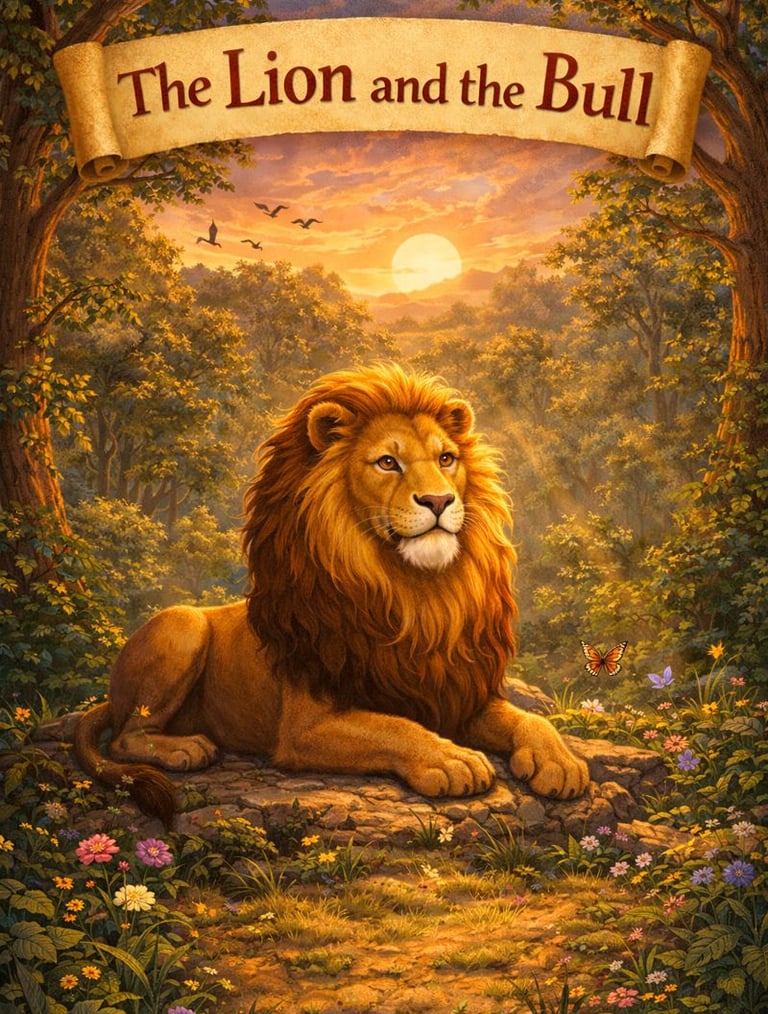
In a land far away, there was a vast and beautiful forest filled with tall trees, colorful flowers, singing birds, and clear streams. All the animals lived together peacefully under the rule of a mighty lion. He was strong, fearless, and respected by everyone. Though powerful, the lion wished for companionship, because even the strongest king can feel lonely.
Little did he know that a simple friendship would soon teach the forest a powerful lesson about trust and truth.
Story:
One warm morning, a bull wandered into the forest. He had been separated from his owner and now roamed freely, searching for food and shelter. The bull was large and strong, and his deep voice echoed through the forest when he called out. When the lion heard this unfamiliar sound, he became alert. Curious but cautious, he went to investigate. Instead of finding an enemy, he saw a calm bull peacefully grazing. The bull bowed respectfully and spoke kindly. The lion realized that the bull was gentle and honest.
Soon, the lion and the bull began spending time together. They talked about life, shared their worries, and protected the forest side by side. The bull admired the lion’s strength, and the lion admired the bull’s honesty. Their friendship grew strong, and the forest became safer and happier than ever before.
The animals rejoiced, but two jackals were unhappy.
These jackals were clever, greedy, and jealous. They once enjoyed the lion’s attention, but now the bull stood close to the king. “If this friendship continues, we will never gain importance,” whispered one jackal. The other nodded, his eyes filled with mischief.
They decided to break the friendship.
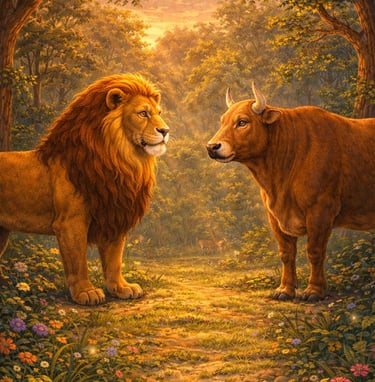
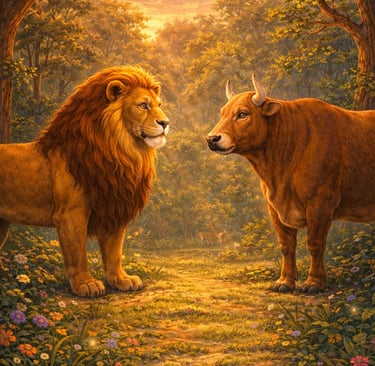
One day, the jackals approached the lion and said softly, “Your Majesty, the bull is becoming proud. We heard him say he is stronger than you.” The lion felt disturbed but stayed silent.
Then the jackals went to the bull and whispered, “Dear friend, the lion doubts you. He thinks you are a threat and plans to attack.”
Confusion entered their minds. The lion began avoiding the bull. The bull felt hurt and lonely. Neither asked the other the truth. Fear replaced trust, and silence replaced friendship.
One afternoon, misunderstanding turned into anger. The lion and the bull stood facing each other, filled with suspicion and pain. Without speaking, they fought fiercely. The forest trembled as dust rose into the air.
In the end, both were badly injured. As the jackals watched from afar, their smiles faded. The forest had lost its peace.
Later, the truth came out. The lion realized how easily he had trusted lies instead of his friend. He understood that his power was useless without wisdom. The bull, too, suffered because he believed rumors instead of speaking openly.
The forest fell silent, carrying the heavy lesson of broken trust.
Moral
👉 Never believe words without truth. Gossip and lies can destroy even the strongest friendships. A wise mind always listens, questions, and chooses trust over fear.
1) The Lion and the Bull:
(Siṁha–Vṛṣabha Kathā - सिंह–वृषभ कथा)