Get flat 10% off, Use code FLAT10

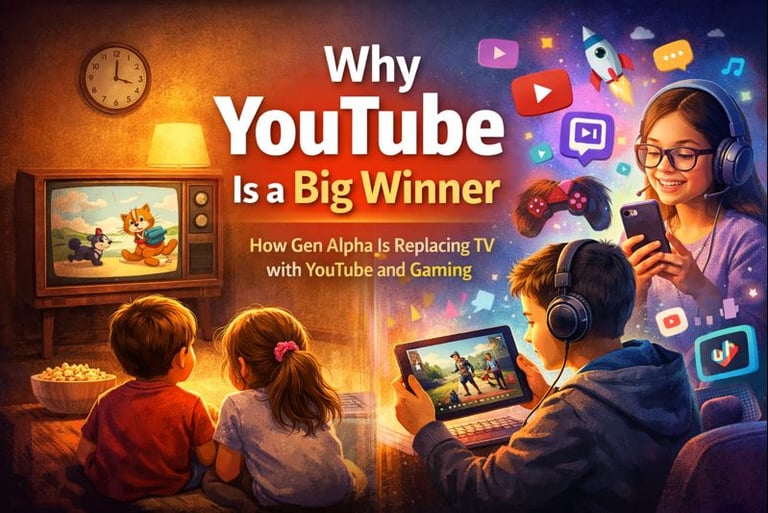
"Why YouTube Is a Big Winner?"
Discover why Gen Alpha kids are choosing YouTube and gaming over traditional TV. This blog explains the shift in kids’ viewing habits, backed by simple insights and real-world trends to help parents understand today’s digital childhood.
GROWING TOGETHER - PARENTING LESSONS
1/23/20264 min read
A few years ago, television was the king of kids’ entertainment. Children waited eagerly for their favorite cartoon time, channels decided what to show, and families often watched together.
Today, that scene looks very different.
Ask a child what they like to watch, and the answer is rarely a TV channel. Instead, you’ll hear names like YouTube, YouTube Shorts, gaming videos, or even live streamers. Television hasn’t disappeared, but it no longer excites children the way it once did.
So why has YouTube become such a big winner for Gen Alpha?
Let’s understand this shift in a simple, real, and practical way.
Meet Gen Alpha: The First Truly Digital Kids
Gen Alpha refers to children born roughly after 2010. These kids did not “learn” technology later in life—they were born into it.
For them:
Touch screens feel natural
Videos feel more normal than books
Choice matters more than routine
According to global digital studies, children today spend more time on online video platforms than on traditional television, and this gap increases every year. In both India and the USA, YouTube consistently ranks as the most-used digital platform among children aged 5–14.
This tells us something important:
YouTube is not just popular—it fits naturally into how Gen Alpha thinks and learns.
Why Traditional TV Feels Outdated to Kids
Television still has good content, but the experience feels old-fashioned to today’s children.
TV works on fixed schedules. You watch what is shown, when it is shown. For Gen Alpha, this feels restrictive.
On the other hand, YouTube gives freedom:
Watch anytime
Pause or rewind
Skip content instantly
Choose exactly what interests them
This sense of control makes a huge psychological difference. Children feel empowered, not passive.
In simple words:
TV talks to kids. YouTube listens to them.
The Power of Choice: Why Kids Open YouTube First
One major reason YouTube wins is variety.
A child can find:
Stories and cartoons
DIY crafts and drawing tutorials
Science experiments
Music, rhymes, and dance
Gameplays and challenges
All on one platform.
Recent viewing data shows that kids often switch between learning content and entertainment content within the same session. For example, a child may watch a cartoon, then a drawing tutorial, and then a short funny video—all within 20 minutes.
Television simply cannot match this level of flexibility.
YouTube Shorts: Small Videos, Big Impact
Short-form videos have completely changed how kids consume content.
YouTube Shorts are quick, colorful, and straight to the point. For Gen Alpha, this format feels exciting and natural.
Studies on attention behavior show that children engage more with short, fast-paced videos, especially when visuals, music, and expressions are strong.
This does not mean kids cannot focus—it means they prefer dynamic content.
Short videos also:
Reduce boredom
Encourage repeat watching
Keep kids curious
That’s why Shorts are watched again and again, often without kids even realizing how much time has passed.
Why Gaming Content Is So Attractive
One surprising trend for many parents is that children don’t just play games—they love watching gaming videos.
Why?
Because gaming content feels alive.
When kids watch a gamer:
They see real reactions
They hear live thinking and decision-making
They learn strategies without effort
Gaming videos often involve problem-solving, creativity, and imagination. Even when a child is just watching, their brain is actively engaged.
In fact, child development experts note that interactive digital content activates more cognitive engagement than passive watching—which explains why kids find gaming content more exciting than regular cartoons.
Twitch and Live Streaming: The Feeling of “Being There”
Platforms like Twitch add another layer: live interaction.
Children love the idea that:
Content is happening right now
Thousands of people are watching together
The creator can respond in real time
This sense of community makes kids feel included.
Television shows are recorded and distant.
Live streams feel personal and real.
Relatable Creators Matter More Than Big Studios
Another important shift is who kids like to watch.
Gen Alpha connects deeply with:
Young creators
Friendly animated characters
Real people sharing real moments
They don’t care if a video is made by a big studio or a small creator. What matters is connection.
This is why many kids remember YouTubers’ names better than TV characters.
What the Data Quietly Tells Us
Let’s keep numbers simple and meaningful.
Children today spend significantly more daily minutes on online video platforms than on TV
Over 70% of kids’ video consumption now happens on mobile devices
Educational and “edutainment” videos are among the fastest-growing categories
These numbers don’t mean TV is bad.
They simply show where children naturally go.
Is This Change Healthy for Kids?
This is the most important question—and the answer is balanced.
YouTube and digital platforms can be very positive when used correctly:
They encourage creativity
They support self-learning
They expose kids to new ideas
At the same time, uncontrolled use can lead to:
Excessive screen time
Reduced physical activity
Irregular sleep patterns
The platform is not the problem.
Guidance is the key.
What Parents Can Do Without Fighting Screens
Instead of strict bans, gentle structure works better.
Parents can:
Encourage quality content
Set simple daily screen routines
Watch occasionally with children
Balance digital time with books, art, and outdoor play
When parents show interest instead of fear, children listen more.
Why This Matters for Kids’ Content Brands
For platforms like The Orange Castle, this shift is an opportunity.
Kids today love:
Visual storytelling
Interactive learning
Short, engaging formats
Characters they can relate to
Books, coloring activities, stories, and songs—when designed with today’s digital mindset—can create a powerful learning experience.
Final Thoughts
YouTube is a big winner not because television failed—but because kids evolved.
Gen Alpha wants freedom, interaction, and connection. They don’t just want to watch stories. They want to be part of them.
As parents, educators, and creators, our role is to guide this digital journey wisely—so children grow not just entertained, but informed, creative, and confident.
🌟 Please visit The Orange Castle regularly for more thoughtful, easy-to-read articles on kids, creativity, and modern learning.